


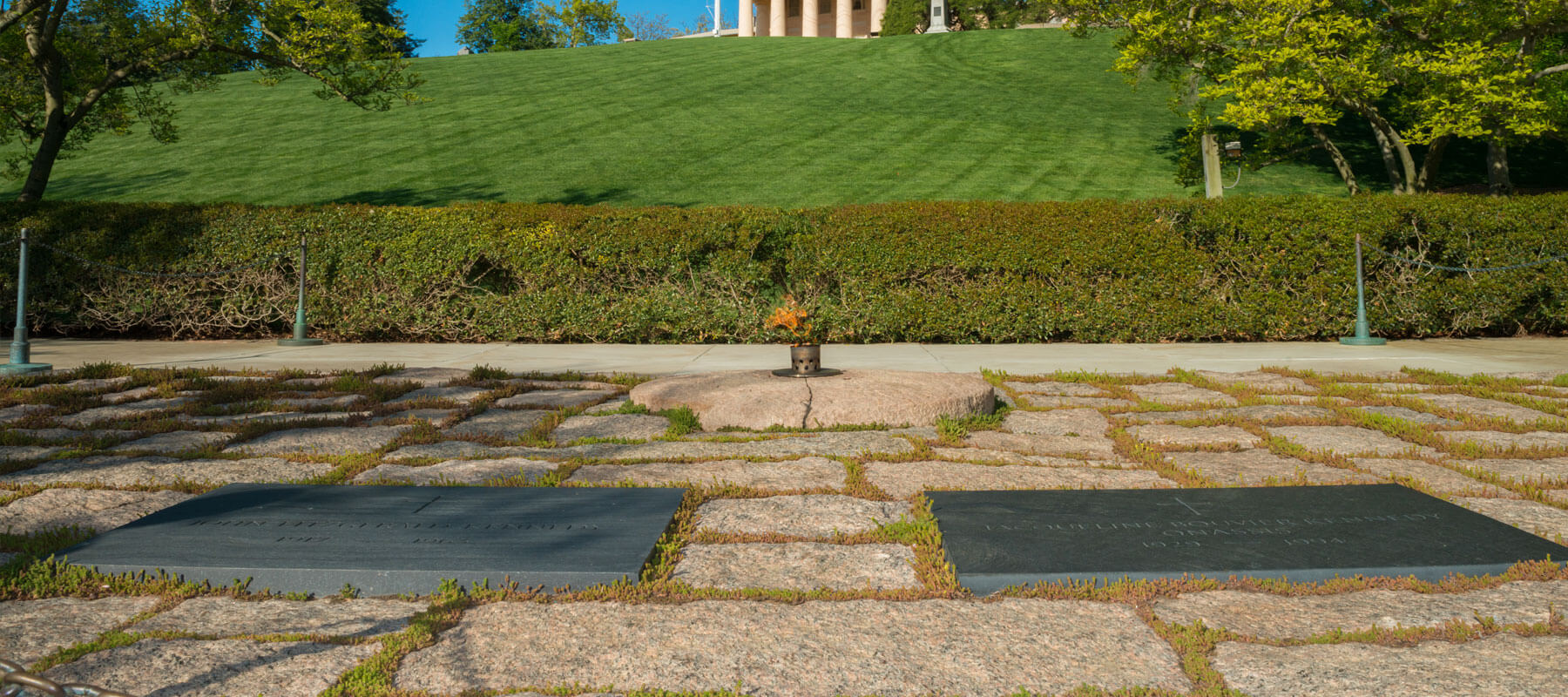
The Best Way to See President John F. Kennedy’s Gravesite
The best way to visit President John F. Kennedy’s gravesite is with Arlington National Cemetery Tours. Our official guided trolley route drops visitors directly at the Kennedy memorial site while providing live historical narration. Riding with Arlington National Cemetery Tours provides a comfortable, informative trip to pay respects at the eternal flame.
Why You Should Visit John F. Kennedy’s Gravesite with Arlington National Cemetery Tours
- Direct Trolley Access: Arlington National Cemetery Tours takes you directly to the Kennedy gravesite at the base of Arlington House hill.
- Live Expert Narration: Learn historical details about JFK’s presidency, military service, and national legacy during your ride.
- Comfortable Transport: Avoid long, uphill walks across the cemetery grounds by riding aboard designated tour vehicles.
- Connected Sightseeing: Connect your visit to other major historic landmarks, including the Tomb of the Unknown Soldier and Arlington House.
Key Facts About President John F. Kennedy
- Arlington Gravesite and Eternal Flame: JFK admired this location during a visit in March 1963, months before his assassination. First Lady Jackie Kennedy requested the eternal flame that adorns the grave.
- Military Honor: Rejected initially due to chronic back problems, JFK joined the U.S. Navy and became the only U.S. President awarded a Purple Heart.
- Presidential Firsts: Kennedy was the first person born in the 20th century, the first Roman Catholic, and the first former Boy Scout elected President.
- Secret White House Tapes: President Kennedy installed a secret recording system in the Oval Office and Cabinet Meeting Room to help document conversations for future memoirs.
- Charitable Donations: As the wealthiest president elected, JFK donated his entire congressional and presidential salaries to various charities.
Born May 29, 1917, John F. Kennedy was the youngest person elected President of the United States when he narrowly defeated the future president Richard Nixon. Commonly known as JFK, the Brookline, Massachusetts native is renowned for a number of exploits during his young life. These include his heroic efforts after the sinking of the PT-109 and winning the Pulitzer Prize for his book “Profiles in Courage.” He was assassinated by Lee Harvey Oswald during a trip to Dallas, Texas on November 22, 1963. Kennedy is buried in a special grave at Arlington National Cemetery along with his wife Jackie and two of their children. The following are 10 additional interesting facts about the 35th president of the United States.
Suffered Lifelong Health Problems
During World War II, Kennedy was originally rejected for military service because he suffered from Addison’s disease and chronic back pain. He wore corrective shoes because his legs were different lengths. He used his father’s political influence to join the U.S. Navy. JFK privately used crutches. The White House swimming pool was heated to 90 degrees so that he could swim to ease his back pain.
Faced Death Several Times
Besides the sinking of the PT-109, JFK was given the last rites three times before he became President. Suffering poor health his entire life, JFK became extremely sick aboard the Queen Mary on a trip back from England in 1947. He experienced an extremely high fever after a trip to Asia in 1951. Kennedy became comatose after back surgery in 1954. In each case, a priest was summoned because his doctors thought that he might die.
A President of Firsts
Kennedy holds the record for a number of firsts. He was the first person born in the 20th century to be elected President. JFK was also the first Roman Catholic president and the first chief executive to have been a boy scout. Kennedy is the only President to have received a Purple Heart. One of Kennedy’s first presidential acts was to create the Peace Corps.
The Country’s Wealthiest President
Born to a wealthy family, Kennedy was the richest man to be elected president. He donated his congressional and presidential salaries to charities, including the Boy Scouts and the United Negro College Fund. Had Kennedy lived, he would have inherited a portion of his father’s estate that was worth an estimated $1 billion.
He Wanted a Cooperative Space Race
After challenging NASA to put a man on the moon, President Kennedy became concerned about the potential costs. As a result, he proposed a cooperative effort between the U.S. and the Soviet Union during a speech at the United Nations as a way to prevent a duplication of effort. Kennedy had opposed the space program as a U.S. senator.
Cigars First, Embargo Second
In addition to ordering the failed Bay of Pigs attack against Cuba, Kennedy was able to avoid war with the Soviet Union and have nuclear missiles removed from Cuba. Before signing the long-running trade embargo against the communist-led island, Kennedy instructed his aides to purchase 1,200 of his favorite Cuban cigars. Under the relaxed trade rules enacted by President Obama, individuals can now purchase up to $100 worth of cigars per visit to Cuba.
Played the Role of Movie Producer
Although the first lady wanted Warren Beatty to play the part, the president used his influence to have Cliff Robertson selected for the lead role in the 1963 movie PT-109. The president was also instrumental in selecting the movie’s director.
Secret White House Tapes
Long before Richard Nixon and Watergate made the taping of White House conversations public knowledge, Kennedy also had a secret taping system. Kennedy probably planned to use the system, which was installed in the Oval Office and Cabinet Meeting Room, to help write his future memoirs. Among the numerous historic conversations are discussions related to the Cuban Missile Crisis.
The Fateful Day
Although first lady Jackie Kennedy rarely traveled with the president on political trips, she accompanied him to Dallas. Abraham Zapruder captured portions of the assassination on film. In 1997, the federal government paid $16 million for the film, which is now stored in the U.S. Archives. It was the last time the Secret Service allowed a sitting president to ride in an open-top limousine.
His Memory Lives On
JFK visited Arlington National Cemetery in March 1963 and admired the view from the site that would be selected for his grave, which was designed by family friend John C. Warnecke. Jackie Kennedy requested the eternal flame that adorns the gravesite. Special equipment controls the color and shape of the flame that remains lit regardless of the weather. Thousands of people visit the grave every day while touring Arlington National Cemetery.