


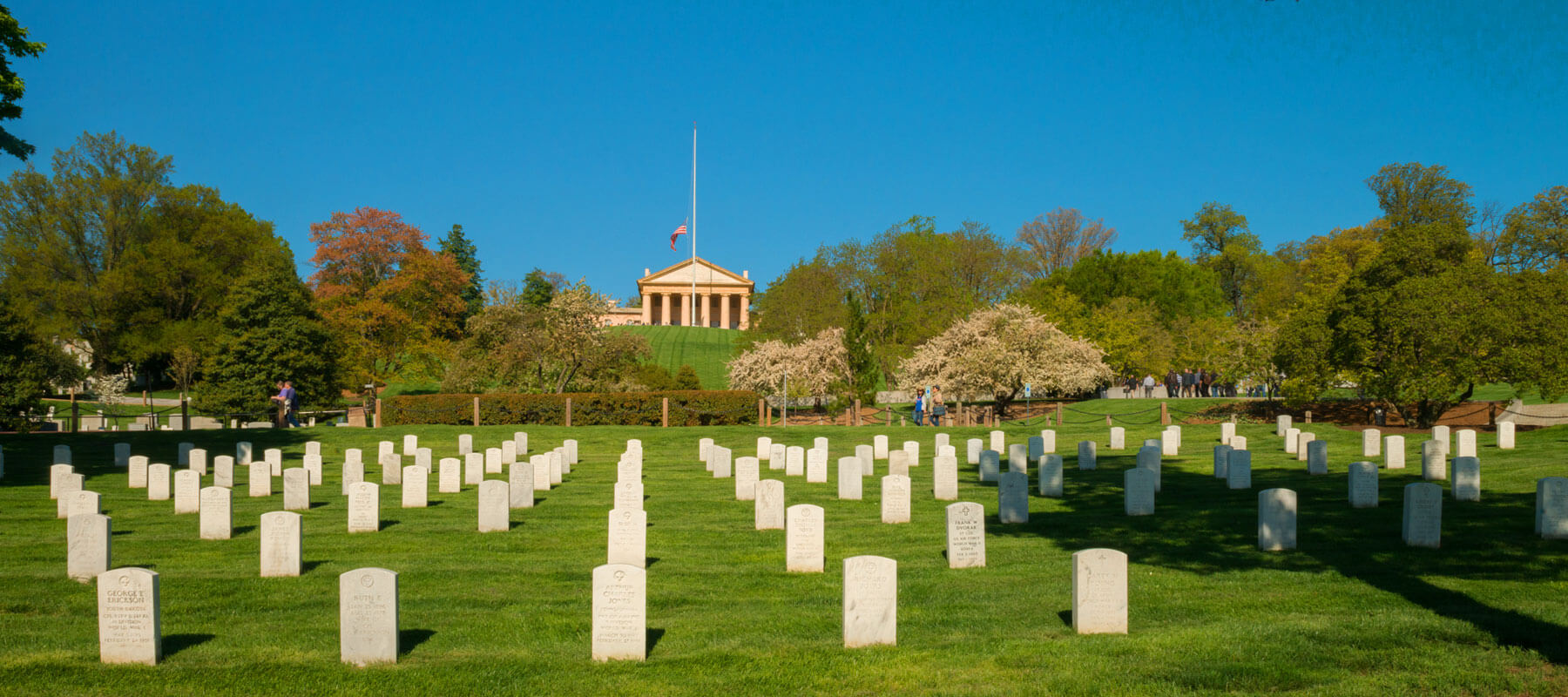
A lasting tribute to the men and women who have died during active military duty, as a retired veteran, or as an elected official while serving our nation, Arlington National Cemetery is visited by millions of people each year.
These hallowed grounds are where more than 400,000 service men and women and their family members are laid to rest. As in any active cemetery, there are funerals held every day that honor those who have died or given their life defending the values and ideals of the United States. If you’re planning a vacation to Washington DC, a visit to Arlington is not something you want to leave off your itinerary.
A Short History
At the outset, this land was not reserved for its current purpose; instead, it was the site of what would become Arlington House back in the year 1802. This estate was the property of the adopted son of George Washington, a man named George Washington Parke Custis. Mr. Parke Custis would eventually bequeath the property to his daughter that enabled her to live there indefinitely on the condition that she never sell it. His daughter, Mary Custis, was the wife of then U.S. Army officer Robert E. Lee and when Virginia eventually broke from the Union, he became the commander of the Army of Northern Virginia and allowed confederate soldiers to use it as an outpost with a high ground that gave them a great military advantage over the Union capital.
Fearing for her life, Mary Lee buried her most valuable possessions on the property grounds and fled to live with her sister elsewhere in the state. Her instinct to leave proved prudent as the estate was later seized by Union Army regulars. Because of the large death toll of soldiers who perished in battle in and around Washington DC, the two cemeteries where war dead were traditionally buried became full. Congress passed legislation allowing the federal government to purchase land for the purposes of a national cemetery. It was the shrewd thinking of Quartermaster General Montgomery C. Meigs that proposed the grounds of Arlington House as the new national cemetery.
Not only was the site ideal because of its elevation that protected it from flooding, but to further embarrass the Confederate cause and embolden the North, it was an opportunity to send a strong message by depriving Robert E. Lee of its use. The first burial took place at Arlington in 1864. There were however, legal wranglings that later took place with the government of the United States and the natural heirs of the property that resulted in a 5-4 Supreme Court ruling that returned Arlington House back to Custis Lee, Robert E. Lee’s granddaughter, on the grounds that it was illegally confiscated. Once in her possession, the land was sold back to the government. Over the years as the United States entered several wars, the cemetery underwent a massive expansion to the hundreds of acres it occupies today.
Getting There
FROM DC
 For guests traveling to Arlington from Washington DC, we’re located across the Potomac River from Washington, DC at the end of Memorial Avenue, the parkway which extends from Memorial Bridge, near the Lincoln Memorial. Along this parkway is the rotary intersection with the scenic George Washington Memorial Parkway.
DRIVING/METRO
Arlington is accessible from the major roadways in the D.C. area like Interstate 95, the Capital Beltway (I-495), the George Washington Memorial Parkway and the Baltimore-Washington Parkway (I-295). The cemetery is also a stop on the Washington Metropolitan Area Transit Authority’s Metrorail system and Metrobus; each are a short walk to the gates of Arlington.
PARKING
Arlington National Cemetery opens to the public daily at 8:00 a.m. and closes at 5:00 p.m. Ample paid parking is available to visitors, accessible from Memorial Avenue. The parking garage closes one hour after the cemetery closes.
OPTIONS FOR EXPLORING
Right off the bat, you have to decide how much time you want to dedicate to such a vast and dense place like Arlington National Cemetery. You can easily spend an entire day here getting lost in the real estate and you still wouldn’t be able to see the whole thing.
OFFICIAL TOUR
 Spread across 639 acres of rolling hills and beautiful gardens, this historic landmark is about four times the size of the National Mall and Arlington National Cemetery Tours provides the official vehicle tour for guests looking to see the entire property in a manageable amount of time. Daily tours begin at the Welcome Center. A 45-minute loop gives visitors the chance to hop on and off at a variety of key points of interest. Don’t miss your opportunity to experience one of the most informative and awe-inspiring tours in Washington D.C.
WALKING TOURS
Be prepared to be on your feet for a considerable amount of time as many walking tours can exceed the three-hour mark and cover roughly two miles. Walking tours are a great option for visitors looking to get exercise and experience certain sections of the property in more detail.
EXPLORE ON YOUR OWN
Experiencing Arlington National Cemetery without a tour guide is not recommended for visitors looking to maximize their time on property. With 639 acres of land, it will be difficult for first-time visitors to navigate and explore the best parts of the cemetery without a guide.
SITES TO VISIT
It was no easy task compiling the most important grave markers and memorials you should visit because, in truth, every single one of them demands respect and is of great importance, especially to the families of those who lie here.
WELCOME CENTER
It is here, located at the entrance to the cemetery, where your tour of one of America’s most esteemed and sacred places begins. More than just a nondescript building with an information desk, The Welcome Center is an elegant, spacious building where visitors access maps, information services, kiosks for downloading ANC Explorer (The official app for the Arlington National Cemetery), a bookstore, restrooms and water fountains. It is the perfect precursor to your tour as you learn about some of the cemetery’s history through museum style displays in anticipation of your journey.
JFK GRAVESITE
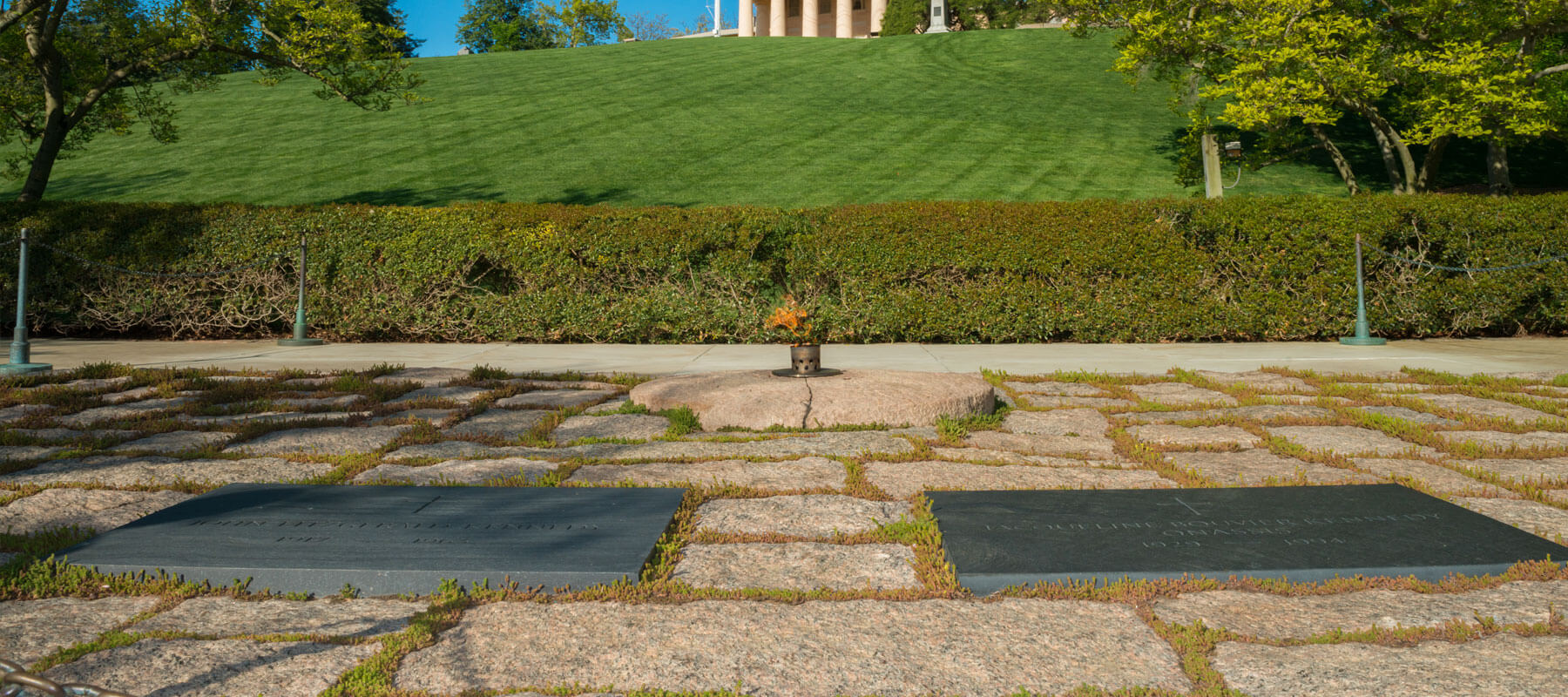 The gravesite of fallen U.S. President John Fitzgerald Kennedy is easily one of the most visited places in all of Arlington National Cemetery. Initially interred in a different part of the cemetery in 1963, a permanent resting place was constructed for him in 1967 that allowed much better access to the millions and millions of visitors that would pay their respects in the years to come.
The stone slab that radiates a flame that lies alongside the grave marker, commonly known as the Eternal Flame, was the idea of his wife and First Lady, Jacqueline Kennedy. She was inspired, in part, by the musical “Camelot” which was the president’s favorite musical and later became synonymous with his administration.
U.S. COAST GUARD MEMORIAL
On an elevated section of the cemetery known as Coast Guard Hill, you’ll find the U.S. Coast Guard Memorial. Made of marble fashioned into a pyramid, this memorial pays tribute to and contains the names of all who perished in two separate events during the First World War, the sinking of both the Seneca and the Coast Guard Cutter Tampa.
JOHN J. PERSHING
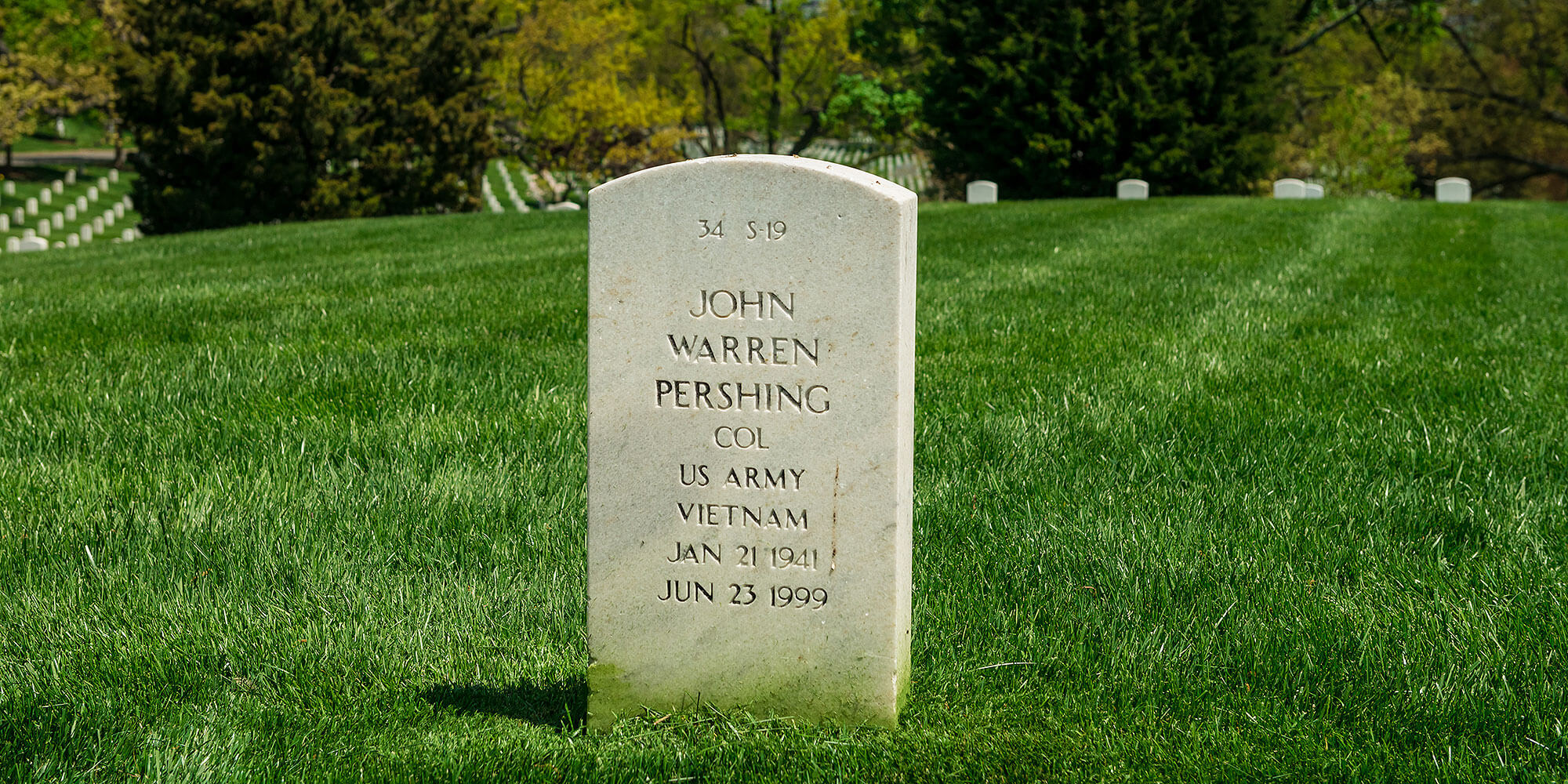 General of Armies. A title so grand, only one person has ever been graced with that rank in their lifetime and his name was General John J. Pershing. Pershing (1860-1948) commanded the American Expeditionary Force (AEF) in Europe during World War I and he served in several wars that played out at the end of the 19th century. He was a man of an iron will, fierce and disciplined, who was buried, without fanfare, near the soldiers he commanded in Europe.
TOMB OF THE UNKNOWN SOLDIER
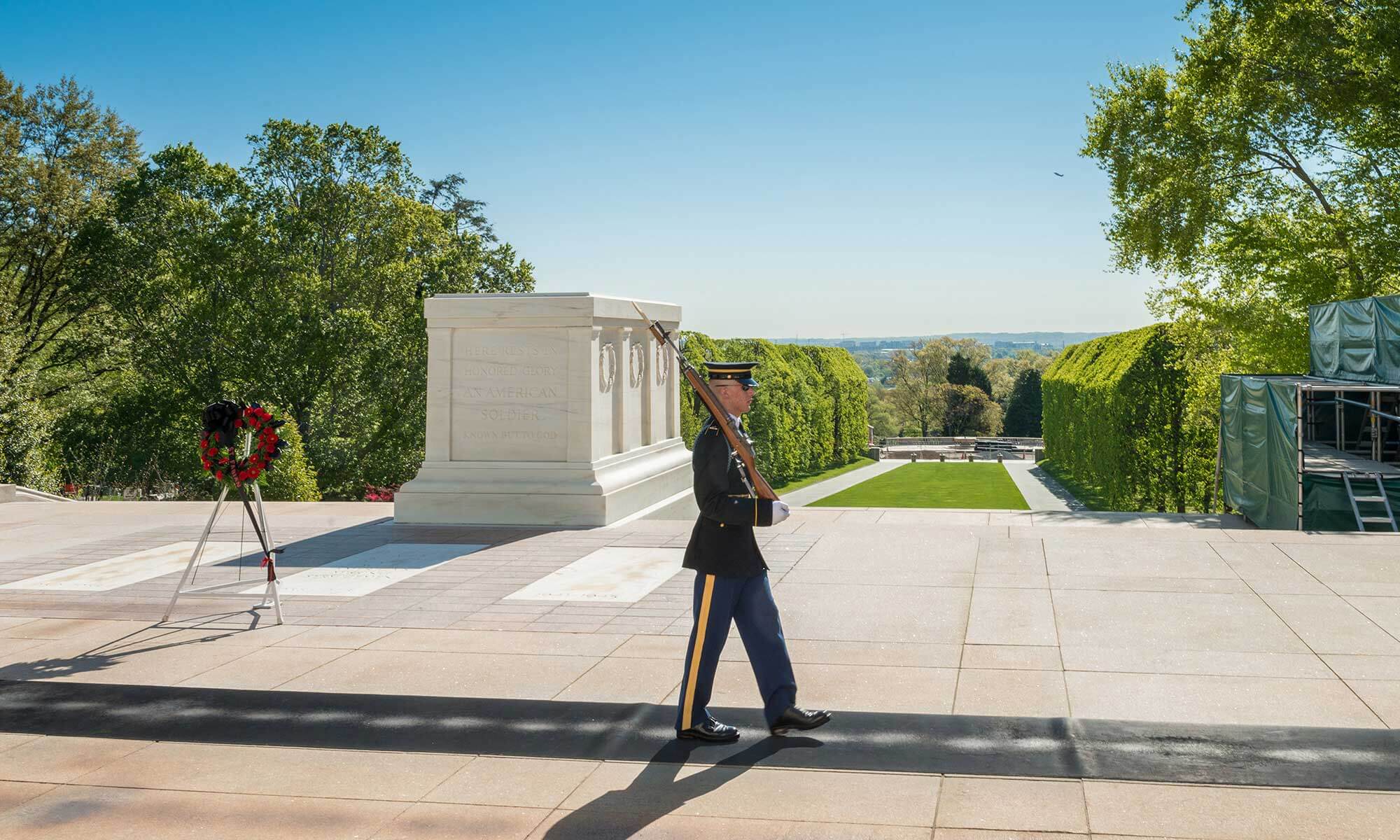 Resonating with an awesome power all its own and a symbol of personal sacrifice, the Tomb of the Unknown Soldier may possess the most mystique of any grave or memorial at Arlington. After the end of World War I, a movement formed to honor soldiers that were killed in battle that could not be identified. The Tomb of the Unknown Soldier contains the remains of such a soldier but the tomb itself speaks for all of those that were not given a proper burial and consigned to anonymity.
The tomb is guarded by members of the 3rd U.S. Infantry Regiment who rotate their duties every hour between October 1 to March 31 and every half hour between April 1 and September 30 in a ceremonial changing of the guard that is the highlight of any visit to Arlington National Cemetery.
ARLINGTON HOUSE
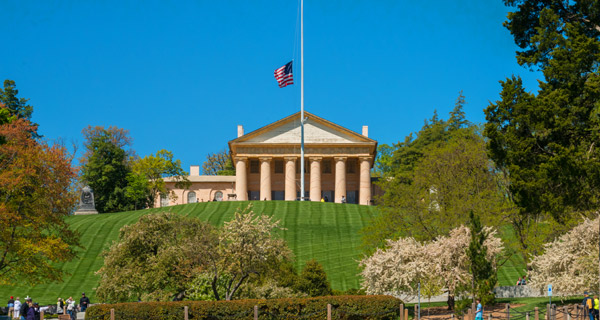 Arlington House is the nation’s memorial to Confederate General Robert E. Lee. He is honored for his role in promoting peace and for advocating the restoration of the union in the aftermath of the Civil War. The home also exists as a place of study and reflection on some of the most difficult trials in this nation’s history.
Arlington House is open for tours. Tickets are available at Recreation.gov.
U.S. MARINE CORPS WAR MEMORIAL
Based on an iconic image of the second flag-raising on the island of Iwo Jima during World War II, the U.S. Marine Corps War Memorial is dedicated to “the Marine dead of all wars and their comrades of other services who fell fighting beside them.” The US Marine Corps War Memorial is located on Arlington Ridge along the axis of the National Mall. A panorama of the Lincoln Memorial, Washington Monument, and Capitol Building are visible from its grounds.
ARLINGTON SECTIONS 55 & 59
This demarcated area of the grounds remind us that Arlington National Cemetery is not some relic by continuing to serve as a place of rest for our fallen heroes with some 30 burials occurring everyday.
ARLINGTON SECTION 60
Section 60 holds the remains of those who served in Iraq and Afghanistan. It is often referred to as the saddest section in the cemetery because family and friends visit regularly and leave flowers and mementos.
ARLINGTON NICHE WALL
The Niche Wall runs along the eastern border of the cemetery and is approximately half a mile in length. Built into this wall are niches where the cremated remains of service members are kept. In addition to the wall, there are nine Columbarium Courts with many thousands of sepulchral recesses in the walls to receive the ashes of fallen loved ones.
PENTAGON GROUP BURIAL MARKER
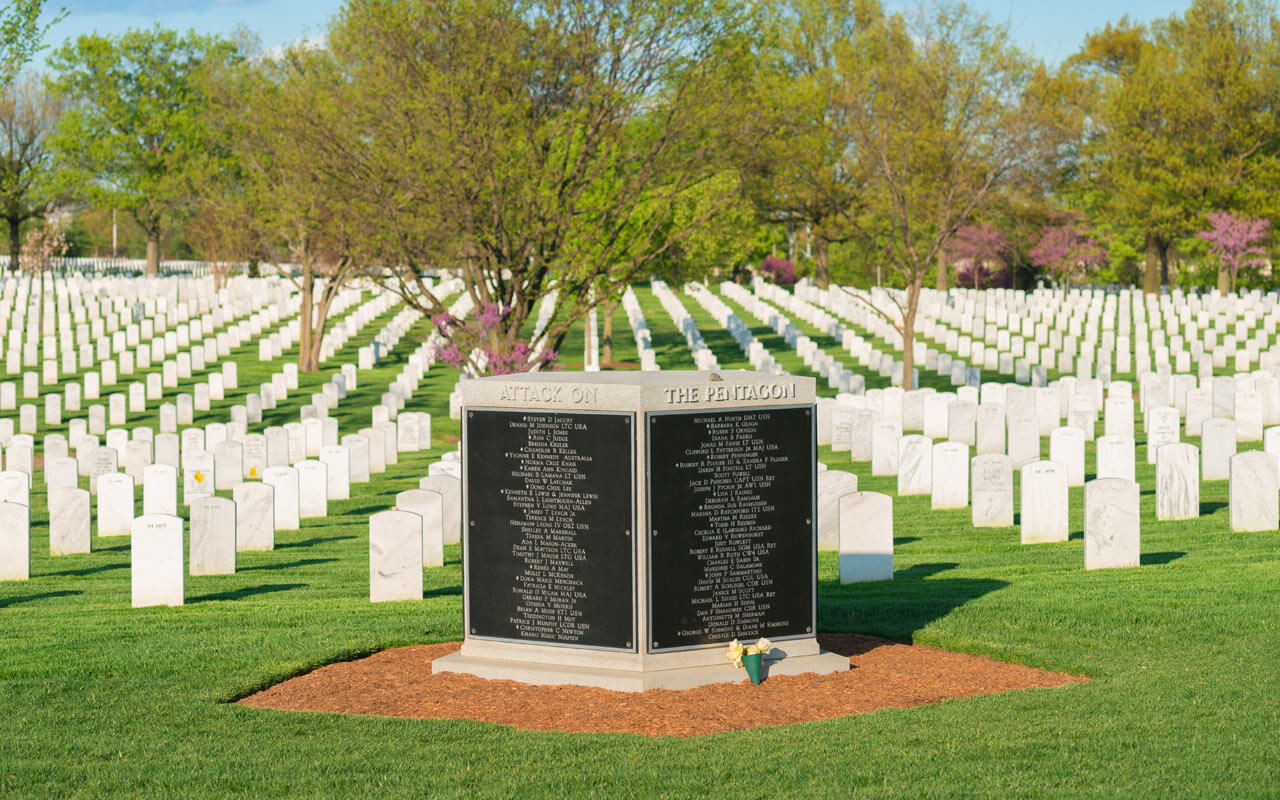 As a solemn tribute to the 184 victims who perished at the Pentagon during the attack on the World Trade Center on September 11, 2001, a group funeral was held at Arlington National Cemetery where their remains were finally laid to rest. The marker, evocative of the Pentagon itself with its five-sided design, holds the names of all who perished in that attack including the passengers of American Airlines Flight 77.
SECTION 5 SUPREME COURT JUSTICES
Section Five is often referred to as the Supreme Court Justice Section because there are approximately half a dozen U.S. Supreme Court Justices buried here. Notables include Chief Justices William H. Rehnquist and Warren Burger and Associate Justices Oliver Wendell Holmes, Potter Stewart, and Thurgood Marshall. Marshall was the first African American to serve on the Court. Prior to becoming a Justice, he argued before the Court most notably during the Brown V. Board of Education case.
CHALLENGER AND COLUMBIA MEMORIALS
Just across the street from the Memorial Amphitheater are the memorials for the Space Shuttle Challenger and the Space Shuttle Columbia. The Challenger exploded on January 28, 1986 just a few seconds after takeoff. All seven crew members, including civilian teacher Christa McAuliffe, perished. The Columbia disintegrated during re-entry on February 1, 2003 killing all seven crew members.
USS MAINE MEMORIAL
This is the actual mast from the USS Maine, which exploded off the Havana Harbor in 1898. Although the cause of the explosion was unknown, the press in the U.S. blamed the Spanish. The rally cry became “Remember the Maine.” Thus, the United States entered the Spanish- American War. Surrounding the memorial are the remains of many of the men who lost their lives on the ship.
ARLINGTON SECTION 27
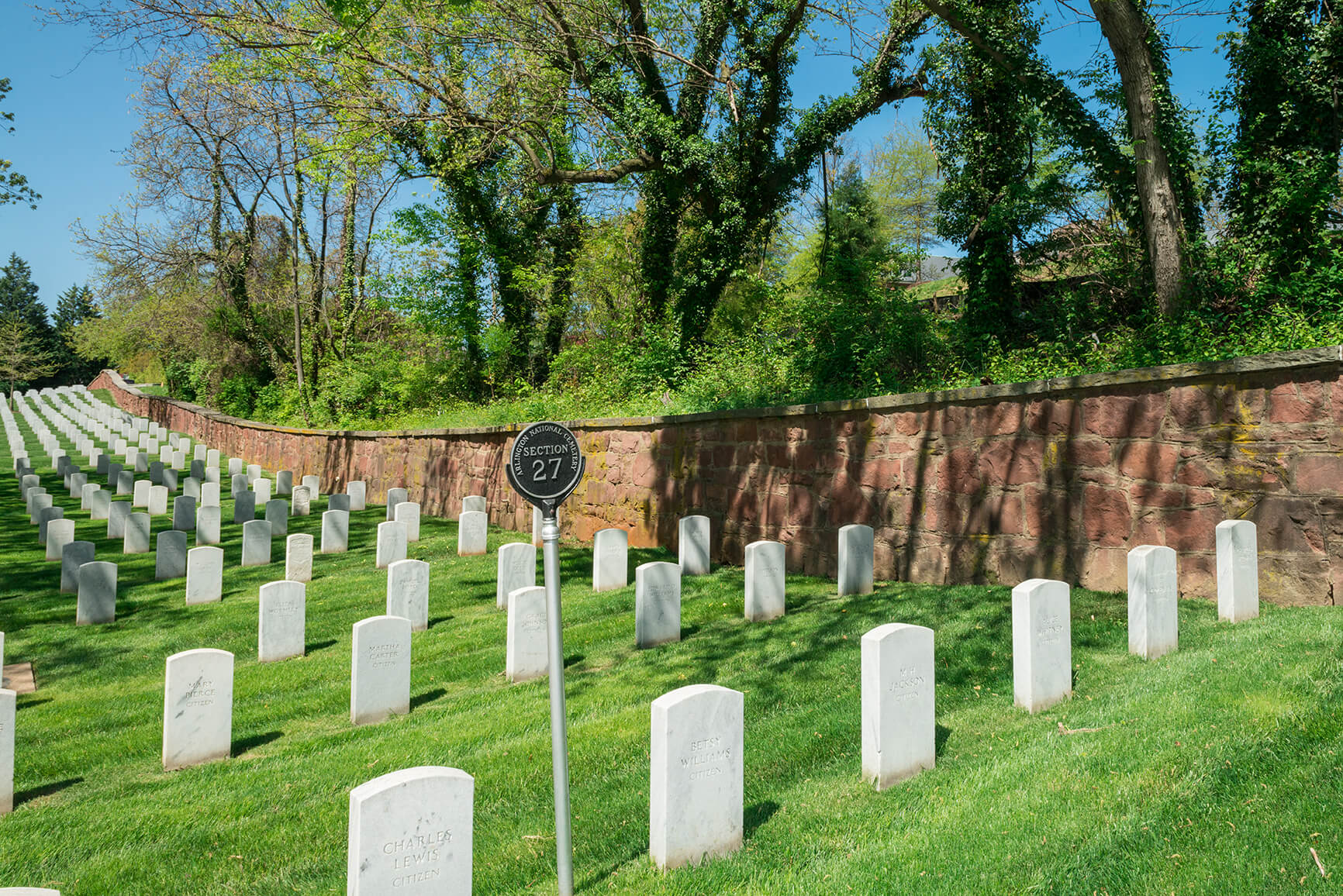 The oldest section at Arlington contains the remains of nearly 4,000 former slaves; their headstones are marked by the words “citizen” and “civilian.” This section also holds the remains of approximately 1,500 United States Colored Troops (USCT), which the official designation was given to all African American units serving in the U.S. Army during the Civil War. Additionally, this section is the resting place for Private William Henry Christman. Interred on May 13th 1864, Christman was the first military burial on the Arlington grounds.
TOMB OF THE CIVIL WAR UNKNOWN
The Tomb of the Civil War Unknown is located near the Arlington House. It holds the remains of 2,111 unknown soldiers from the Battle of Bull Run. The monument was erected by order of General Montgomery C. Meigs with the intent of deterring the Lees from returning to the Arlington grounds.
NETHERLANDS CARILLON
The bell tower, located just outside the Ord and Weitzel gate, is a gift from the Netherlands to the U.S. for liberating them from the Nazis during World War II. The tower contains 50 bells which weigh approximately 30 tons. The bells play a medley of the armed forces anthems at noon and 6 PM and they chime every 15 minutes.